
Part of our Contractor Guides

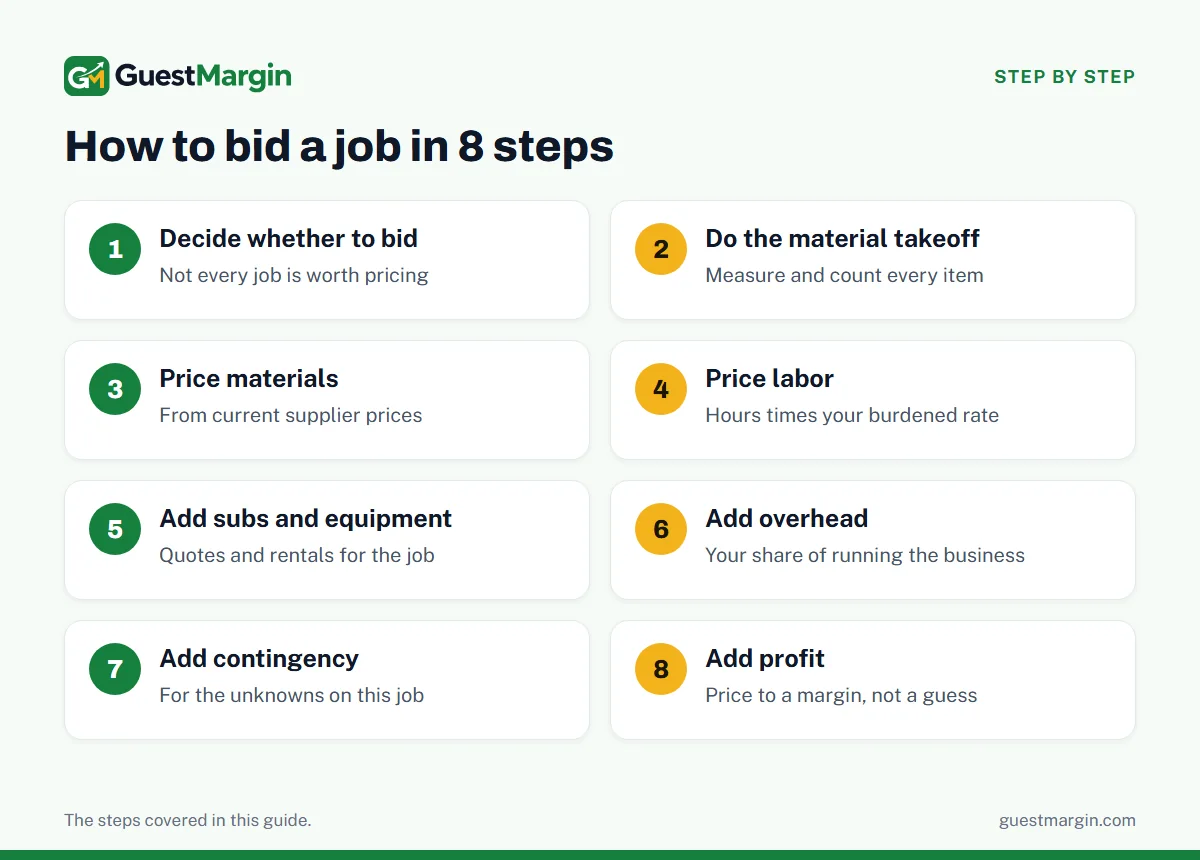
To bid a job, add up direct costs (materials, labor at your burdened rate, subcontractors and equipment), add your overhead recovery and a contingency sized to named risks, then set the price to your target margin: price = total cost / (1 – margin). Write the scope, exclusions and expiry before you send it.
This is the method for how to bid a job when you need a number you can defend, not a guess. It is the same arithmetic whether you are working out how to bid a construction job for a whole remodel or pricing a one-day repair. The number then goes into the document you send the client, so this guide pairs with writing a contractor estimate.
Two omissions can sink a bid even when material prices are right. The first is hours you pay for but cannot bill. The second is overhead added as a vague markup instead of recovered per job.
How to bid a job: the formula
The bid formula is: price = (materials + labor + subcontractors + equipment + overhead recovery + contingency) / (1 – target profit margin). Every line is calculated, not guessed, and each step below produces one of those numbers. The table shows how each line is calculated, using the worked example later in this guide.
| Line | How to calculate | Example (illustrative) |
|---|---|---|
| Materials | Takeoff quantity (plus waste factor) x unit cost from the supplier, plus tax you pay | $1,836 |
| Labor | Estimated hours x burdened cost per billable hour | 24 x $47.50 = $1,140 |
| Subcontractors and equipment | Written sub quotes + rental, disposal, delivery | $250 |
| Overhead recovery | Labor hours x overhead rate per hour | 24 x $25 = $600 |
| Contingency | Cost of the named risks you are carrying | $300 |
| Total cost | Sum of the above | $4,126 |
| Price | Total cost / (1 – target margin) | $4,126 / 0.90 = $4,584.44, rounded to $4,590 |
Whether the client sees this as an estimate, a quote or a bid depends on how much price certainty you are giving. If you are unsure, read the difference between an estimate, a quote and a bid.
Step 1: Decide whether to bid at all
Knowing how to price a job starts with deciding whether to price it. Not every job is worth bidding. Before you spend hours pricing, check four things: is the scope clear enough to price, will this client pay on time, does the job fit your schedule and crew, and can you compete on something other than price alone? If two of the four are weak, pass or price the risk in.
- Scope clarity: Are there drawings or a clear description? Vague scope means a contingency or an estimate with stated assumptions.
- Payment risk: Is a deposit possible? Who signs? For larger jobs, how will you be paid as work progresses?
- Schedule fit: Will this job push a better one back?
- Competition: If the client is collecting many bids and choosing the lowest, your margin is what gets cut.
Track your win rate (bids won divided by bids sent). Winning almost every bid can mean you are priced too low; winning almost none points to price, scope or the kind of clients you are bidding for.
Step 2: Do the material takeoff
Learning how to estimate construction costs starts with quantities. A material takeoff converts the scope into quantities: square feet, linear feet, counts, cubic yards. Measure from plans or on site, list every material, then add a waste factor using the manufacturer’s installation guidance for that product, since the right allowance depends on the material, layout and pattern.
Work area by area, and separate what you supply from what the client supplies. A structured form helps: the free construction estimate template lays out labor, materials and subs by line.
Trade templates carry the right units. Roofers measure in squares and pitch in the roofing estimate template; painters measure by room, square footage and coats in the painting estimate template; and the free landscaping estimate template handles materials by the cubic yard.
Step 3: Price materials
Price materials from current supplier quotes, not last month’s receipt. Work out a unit cost for each item (per sq ft, per piece, per yard), note how long each price is valid, add delivery, and handle sales tax the way your state requires, because in some states the contractor pays tax on materials as the consumer and builds it into the price.
Sales tax treatment varies by state and by type of work. California treats construction contractors as the consumers of materials they furnish and install (CDTFA Publication 9), so the tax you pay is a material cost. In Texas, labor to repair or remodel residential real property is not taxable, while the total charge for nonresidential repair and remodeling is (Texas Comptroller Publication 94-116). Check your state revenue department; this is not tax advice.
Set your bid’s expiry to match the shortest supplier price window.
Step 4: Price labor
Labor cost is estimated hours multiplied by your burdened cost per billable hour, not the hourly wage. The burdened rate adds payroll taxes, workers’ compensation, insurance and benefits, then spreads that cost over only the hours you can actually bill.
Estimate hours from crew size and your own production rates: a two-person crew for three eight-hour days is 48 paid hours. Then price each hour at the burdened rate.
Illustrative example: a $30 wage. The employer share of Social Security and Medicare is 7.65% (IRS Topic 751), which adds $2.30. Suppose workers’ comp, unemployment insurance and benefits add another $5.70 in your state and policy. That is $38.00 per paid hour.
Now the step that is easy to miss. If only 80% of paid hours are billable (the rest is drive time, supply runs and shop time), each billable hour costs $38.00 / 0.80 = $47.50. Price at $30 and you lose $17.50 on every billable hour before overhead.
Our guide on labor burden covers every component, and you can calculate your burdened labor rate with your own numbers. For production rates, use your own job records.
Step 5: Add subcontractors and equipment
Get subcontractor quotes in writing, with their scope and exclusions, and make sure their scope matches yours. Add equipment rental, dumpsters, disposal fees and delivery as separate lines. Whether you mark up subcontractor costs is a business choice, but some contracts set or limit it.
Gaps between scopes hide unpaid work: if the electrician excludes patching and your bid is silent, the patching is yours.
Job-specific general conditions belong here too: dumpsters, temporary protection, permits, portable toilets and on-site supervision for this job. Costs that exist whether or not you win the job go in overhead instead.
Step 6: How do you calculate overhead for a bid?
Calculate overhead by dividing your annual overhead costs by your annual billable labor hours, which gives an overhead rate per hour to add to every job. Alternatively, divide annual overhead by annual direct job costs to get a percentage. Either way, every job carries its share.
Overhead, also called indirect costs, is everything you pay to stay in business that is not tied to one job: vehicles, insurance, phone, software, office, marketing, accounting, and your own unbilled admin time.
Here is how to calculate overhead with each method. Illustrative example: annual overhead of $60,000 and 2,400 billable hours across your crew gives $60,000 / 2,400 = $25 per billable hour. A 24-hour job carries 24 x $25 = $600 of overhead.
The percentage method: if annual direct job costs are $300,000, overhead is $60,000 / $300,000 = 20% of direct cost. On a job with $3,226 of direct cost, that is $645.20. The hourly method suits labor-heavy work; the percentage method suits material-heavy work.
For context only, NAHB reports that remodelers’ operating expenses averaged 23.6% of revenue in fiscal 2024 (NAHB Remodelers’ Cost of Doing Business Study, 2026 edition). Use your own books to set your rate; an industry average is not your overhead.
Step 7: How much contingency should you add?
Size construction contingency to risks you can name in this job, not to a universal percentage. List what could go wrong (hidden rot, an uneven subfloor, a longer tear-off), estimate what each would cost, and carry the likely ones. Unknowns you cannot price belong in the exclusions or as unit prices.
Contingency vs allowance
Contingency and allowances are different. An allowance is a stated budget for something the client has not chosen yet (“tile allowance: $X per sq ft”), shown on the estimate and adjusted to actual. Contingency is your internal cushion for your own risk.
When a risk turns out to be bigger than the contingency, or the client adds work, that is a change order. Know how to write and price a change order before you need one.
Step 8: Add profit by pricing to a margin
Set the price from your target profit margin with price = total cost / (1 – margin). For a 10% margin on $4,126 of cost, price = $4,126 / 0.90 = $4,584.44. Adding 10% to cost instead gives $4,538.60, which is only a 9.1% margin.
Markup is a percent of cost; margin is a percent of price. If your target is set as a margin, divide; do not multiply. Our guide to converting markup to margin has the full conversion table, and the free markup and margin calculator does it for any number.
Why “10 and 10” overhead and profit is 21%, not 20%
“10 and 10” means 10% overhead plus 10% profit, applied in sequence. On $10,000 of cost: $10,000 x 1.10 = $11,000, then $11,000 x 1.10 = $12,100. That is 21% on cost, not 20%, because the profit is calculated on cost plus overhead. As a share of the $12,100 price, the $1,100 of profit is a 9.1% margin.
Worked example: bidding a small job
Here is a full bid for installing 400 sq ft of laminate flooring in a house, with a two-person crew. Every quantity, price, rate and tax figure is illustrative, chosen to show the arithmetic, not a market rate for your area. Swap in your own takeoff, supplier quotes and rates.
| Line | Calculation | Amount |
|---|---|---|
| Laminate flooring | 440 sq ft (400 + 10% illustrative waste) x $3.00 | $1,320.00 |
| Underlayment | 440 sq ft x $0.50 | $220.00 |
| Transitions and trim | Lot | $160.00 |
| Tax paid on materials | $1,700 x 8% (illustrative; varies by state) | $136.00 |
| Materials total | $1,836.00 | |
| Labor | 24 billable hrs x $47.50 | $1,140.00 |
| Disposal and haul-away | Quote | $250.00 |
| Direct cost | $1,836 + $1,140 + $250 | $3,226.00 |
| Overhead recovery | 24 hrs x $25 | $600.00 |
| Contingency (subfloor patching) | 4 hrs x $47.50 + $110 materials | $300.00 |
| Total cost | $3,226 + $600 + $300 | $4,126.00 |
| Price at 10% margin | $4,126 / 0.90 = $4,584.44, rounded up | $4,590.00 |
| Profit | $4,590 – $4,126 | $464.00 (10.1% of price) |
If the subfloor turns out fine, the $300 contingency becomes extra profit. If it is worse than four hours of patching, the exclusions and change-order clause on the estimate cover the difference. The client sees grouped prices for flooring, prep and disposal, not your overhead or contingency lines.
When the client accepts, invoice the deposit, then bill the balance on completion. See invoicing a deposit or a final payment and how to word your payment terms.
Fixed price, time and materials, cost-plus or unit price?
The pricing method decides who carries the risk. With a fixed price you carry it; with time and materials or cost-plus the client carries most of it; with unit pricing the risk is split, because the rate is fixed but the quantity is not. Pick the method that matches how well you can define the scope.
| Method | Who carries the risk | When to use | What the estimate must show |
|---|---|---|---|
| Fixed price (lump sum) | Contractor | Clear, measurable scope | Scope, exclusions, total, expiry |
| Time and materials | Mostly client | Repairs and unknowns | Hourly rate, material markup, a not-to-exceed amount if the client wants a cap |
| Cost-plus | Mostly client | Custom work, trusted clients | What counts as cost, the fee or percentage, how costs are documented |
| Unit price | Shared | Repeatable work with uncertain quantity | Rate per unit, estimated quantity, how quantity is measured |
For larger jobs billed over months, a fixed price is often paired with a schedule of values and monthly billing. See how construction pay apps work.
What are the most common bidding mistakes?
The most common bidding mistakes are pricing labor at the wage instead of the burdened billable rate, leaving overhead out, confusing markup with margin, skipping exclusions, sending a bid with no expiry, and having no change-order clause. Each one quietly moves money from your profit to the client.
- Unbillable time: drive time and supply runs are real costs. Spread them over billable hours.
- No overhead recovery: overhead not in the price comes out of your profit.
- Markup/margin confusion: 10% added to cost is a 9.1% margin.
- Missing exclusions: anything not excluded can be argued as included.
- No expiry: your price should not outlive your supplier quotes.
- No change-order clause: extra work without one is hard to bill.
Doing this in an app can save time on repeat jobs; compare contractor invoicing software if you bid often.
Frequently Asked Questions
How do you calculate a bid for a construction job?
Add materials, labor at your burdened rate, subcontractors and equipment to get direct cost. Add overhead recovery (your overhead rate per labor hour, or a percentage of direct cost) and a contingency for named risks. Then divide the total by one minus your target margin. For a 10% margin on $4,126 of cost, the price is $4,126 / 0.90 = $4,584.44.
What is overhead and profit in construction?
Overhead and profit (O&P) is the amount added to direct job costs to cover the costs of running your business and to earn a return. Overhead covers vehicles, insurance, office and admin; profit is what remains after all costs. “10 and 10” O&P, applied in sequence, adds 21% to cost, not 20%.
How much contingency should a contractor add to a bid?
There is no universal percentage that fits every job. Size contingency to the specific risks in this job: list what could go wrong, estimate the cost of each, and carry the likely ones. Risks you cannot price belong in the exclusions or as unit prices for extra work, approved by change order.
Should I bid by the hour or by the job?
Bid by the job (fixed price) when you can measure the full scope, because many clients prefer certainty and you keep the upside if you work efficiently. Bid by the hour (time and materials) when hidden conditions make the scope unknowable, such as diagnostic repairs. You can also combine them: a fixed price with unit prices for defined extras.
How do I price a job I have never done before?
Break it into tasks you have done, estimate each, and add contingency for the parts that are new. Get written quotes from suppliers and any subs, and ask manufacturers for installation guides to understand labor and waste. Price conservatively, state your assumptions in the estimate, and track your actual hours so the next bid is based on your own data.
The bottom line
A good bid is arithmetic, not instinct: direct costs at real prices, labor at the burdened billable rate, overhead recovered per job, a contingency you can explain, and a price set to the margin you want. Then wrap it in a clear scope with exclusions and an expiry.
For the document side, see the full estimating guide. When your numbers are ready, put them into the free maker (no signup) and save a PDF estimate in minutes.