
Part of our Contractor Guides

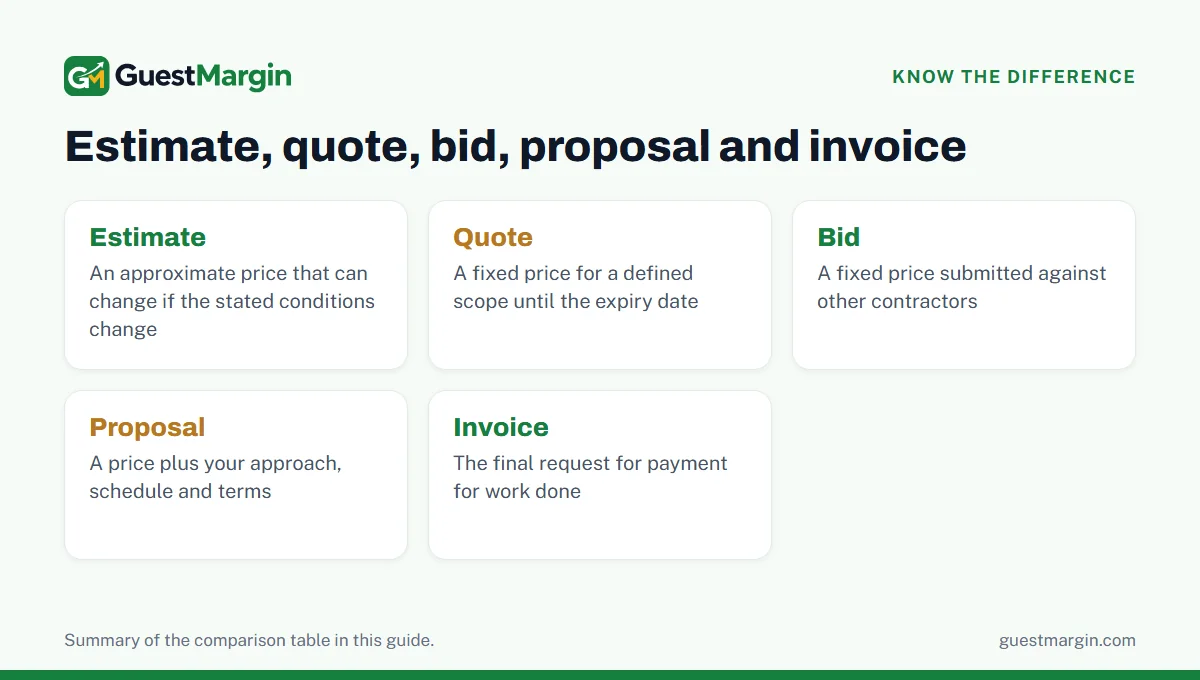
Estimate vs quote comes down to price certainty: an estimate is an approximate price that can change if the conditions it states change, while a quote is a fixed price for a defined scope that holds until a stated date. A bid is a price submitted in competition, and a proposal adds your approach, schedule and terms.
Clients use these words interchangeably, and contractors often do too. What actually protects you is the wording on the page, not the label at the top. A “quote” with an expiry date and an exclusions list is safer than an “estimate” with neither.
The real difference between quote and estimate pricing is who carries the risk if quantities or conditions change. This guide explains each document, when to send which, and how to word it. For the full process of building the document itself, see our guide on how to write an estimate.
Quote vs estimate vs bid vs proposal: what is the difference?
An estimate forecasts the price and can move with stated conditions; a quote fixes the price for a defined scope and period; a bid is a price offered in competition, often under formal rules; a proposal packages a price with approach, schedule and terms; and an invoice bills for work already agreed and done. The table compares them side by side.
| Document | Price certainty | When it is used | Binding? | Typical format |
|---|---|---|---|---|
| Estimate | Approximate; can change if stated conditions change | Repairs, hidden conditions, early budgeting | Depends on wording, acceptance and state law | Itemized scope, assumptions, expiry |
| Quote | Fixed for the defined scope until the expiry date | Clear, measurable scope | Usually, once accepted | Itemized scope, fixed total, expiry, signature |
| Bid | Fixed, submitted against other contractors | GC packages, public works, competitive jobs | Often binding once submitted, per the bid rules | Follows the owner’s bid form or RFP |
| Proposal | Fixed or estimated, plus approach and schedule | Larger jobs, design-build, competitive sales | Once signed | Narrative, scope, price, schedule, terms |
| Invoice | Final, for work done | Deposit, progress or completion billing | A request for payment under the agreement | Line items, amounts paid, balance due |
What is an estimate?
An estimate is your best written forecast of what a job will cost, based on the conditions you can see. It is the right document when something you cannot measure yet could change the price, such as what is behind a wall, the condition of a subfloor, or how far a leak has spread.
A good estimate names those conditions. “Assumes framing is sound; rot repair priced per linear foot if found” tells the client in advance how the price could move and why.
The number itself still needs real pricing: quantities, labor hours at your loaded rate, overhead, contingency and profit. Our guide on how to bid a job walks through that build-up, and the free construction estimate template gives you the structure to fill in.
What is a quote?
A quote is a fixed price for a defined scope, valid until a stated date. Send a quote when you can measure everything that drives the cost, such as a fixture swap, a fence of known length, or a room repaint. The client gets certainty; you carry the risk if your numbers are wrong.
Because you carry that risk, a quote needs three protections: a tight scope of work, an exclusions list, and an expiry date tied to how long your suppliers hold their prices. Extra requests are a change order, and you should be getting extra work signed before you start it.
What is a bid?
A bid is a price you submit through competitive bidding against other contractors, usually against plans and specifications someone else wrote. Private bids follow whatever rules the owner or general contractor sets. Public-works bids follow procurement law, which is strict about deadlines, forms and bonds.
For federal contracts, sealed bidding is governed by FAR Part 14: bids are opened publicly and award goes to the responsible bidder whose conforming bid is most advantageous to the government, considering only price and price-related factors. State and local public bidding follows each state’s procurement code and varies by state, so read the bid documents and your state’s rules before you submit.
That is the heart of bid vs quote, and of estimate vs bid: a bid is priced against other contractors on someone else’s documents and deadline, while a quote or estimate is your own document for one client.
Because a submitted bid can be hard to withdraw, the pricing has to be right before the deadline. Make sure you know why markup and margin are not the same number; mixing them up is an easy way to bid a job at a smaller profit than you intended.
What is a proposal?
A proposal is an estimate or quote wrapped with the case for hiring you: your approach, materials options, schedule, warranty, and terms and conditions. It beats a bare price when the client is comparing contractors on more than cost, or when the job is large enough that how you will do it matters as much as what it costs.
In proposal vs estimate terms, the estimate is the price and the proposal is the price plus the reasons to choose you. A proposal is also where options belong. “Option A: builder-grade fixtures. Option B: upgraded fixtures” lets the client choose without you rewriting the estimate twice. For multi-month projects, the proposal should also show the payment schedule, and whether you will use progress billing against a schedule of values.
Where does the invoice fit?
The invoice comes after the agreement. A quote or estimate asks “will you pay this for that?”; an invoice says “you agreed, the work is done, here is what you owe.” The final invoice should mirror the accepted quote or estimate plus any signed change orders, line for line, minus deposits already paid.
That is the quote vs invoice difference: one prices future work, the other bills completed work. If the invoice total differs from the accepted estimate, the difference should trace to a signed change order. Here is what a contractor invoice should include, and our guide to deposit and late-fee terms covers due dates.
Is an estimate or a quote legally binding?
It depends on the wording, whether the client accepted it, and your state’s law. A signed quote or estimate with a defined scope and price can form a contract. A document clearly labeled as approximate, with stated conditions, leaves more room to adjust, but not unlimited room. In general contract terms, your signed document can be the offer and the client’s signature the acceptance; offer and acceptance on a defined scope and price is what can make it binding. This is general information, not legal advice.
Some industries have specific rules, and they do not carry over to construction. Interstate household-goods movers, for example, have a formal binding vs non-binding estimate distinction under federal rules (49 CFR Part 375). California auto repair shops must get the customer’s authorization before charging beyond the original estimate (California Bureau of Automotive Repair). Neither rule governs a contractor’s estimate.
For construction, your state’s home improvement or contractor laws may require written contracts, specific wording, or limits on deposits. California’s Contractors State License Board, for example, says changes to the work should be recorded on a written change order that becomes part of the contract (CSLB). Check your state licensing board, and ask a local attorney for anything contract-specific.
Which one should you send?
Send a quote when you can measure the full scope, an estimate when hidden conditions could change the price, a bid when you are competing on someone else’s documents, and a proposal when the job is large or the client is choosing on more than price. The table matches common job types to the document.
| Job type | Send | Why | Must include |
|---|---|---|---|
| Small fixed-scope job (fixture swap, repaint) | Quote | Everything is measurable | Scope, exclusions, total, expiry, signature |
| Repair with unknowns (leak, rot, old wiring) | Estimate | Conditions behind the wall drive cost | Assumptions, unit prices for extra work, change-order clause |
| Competitive GC or public bid | Bid | Owner sets the format and rules | Owner’s bid form, required bonds, deadlines |
| Large remodel or design-build | Proposal | Approach, options and schedule matter | Options, schedule, payment schedule, allowances |
All four can be made in the same place. Our free estimate and invoice maker has a document-type switch for estimate, quote, invoice and change order, so the format stays the same as the job moves from price to bill. If you want sending, e-signature and payments too, compare software that sends estimates and gets you paid.
How do you word an estimate so it protects you?
Protective wording comes down to five lines: an expiration date, an exclusions list, any allowances with their dollar amounts, a “subject to site conditions” assumption, and a change-order clause. Together they tell the client exactly when and how the price can change.
- Expiry: “This estimate is valid until [date]. Prices after that date are subject to revision.”
- Exclusions: “Excludes permit fees, electrical work, and repair of concealed damage.”
- Allowances: “Tile allowance: $4.00 per sq ft. Selections above the allowance are billed at the difference.”
- Site conditions: “Price assumes sound subfloor. Replacement, if needed, billed at $X per sq ft after client approval.”
- Change orders: “Changes to scope are priced and signed on a written change order before the work proceeds.”
If a client wants a ceiling on an estimate, you can add a not-to-exceed amount (“Total will not exceed $X without a signed change order”). That makes the estimate behave more like a quote, so price that risk in. The dollar figures above are placeholders; use your own. If an assumption depends on labor, price the extra work at your loaded rate, not the wage. Our guide to what labor really costs per billable hour shows how to get that number.
Frequently Asked Questions
Is a quote more binding than an estimate?
Generally, yes. A quote commits to a fixed price for a defined scope, so once the client accepts it you are expected to deliver at that price. An estimate signals the price can change under stated conditions. In both cases, what binds you is the wording and the acceptance, and the rules depend on your state. This is not legal advice.
Can a contractor charge more than the estimate?
Only in the ways the estimate and your agreement allow. If the estimate states assumptions and the conditions turn out different, or the client requests changes, the extra cost should go on a signed change order before the work. Charging more without that is a common source of disputes. Your state’s home improvement rules may also apply.
What is a binding estimate?
A binding estimate is a price the provider commits to, regardless of how the job turns out within the stated scope. The term is defined in federal rules for interstate household-goods moves (49 CFR Part 375). In contracting, a “binding estimate” is effectively a quote: a fixed price for a defined scope, which you should label and word as such.
Is a bid the same as a quote?
Close, but not the same. Both are fixed prices. A bid is submitted in competition, usually on the owner’s documents and deadline, and may be governed by formal rules such as FAR Part 14 for federal sealed bidding or state procurement codes. A quote is usually your own document, sent to one client for one job.
Is a quote the same as an invoice?
No. A quote prices work before it starts and asks for acceptance. An invoice bills for work that was agreed and completed, and asks for payment. The final invoice should match the accepted quote plus any signed change orders, less deposits paid. Our free maker has a “Convert to invoice” button that does this for an accepted quote.
The bottom line
Pick the label that matches who carries the risk: quote when you can measure everything, estimate when you cannot, bid when you are competing, proposal when the job is big. Then make the wording do the protecting: scope, exclusions, allowances, expiry and a change-order clause.
For the full build, read our step-by-step estimate guide, then make your estimate or quote in our free estimate, invoice and change order maker. It is the same tool either way; just pick the document type.