
Part of our Contractor Guides
Here is how to write an invoice as a contractor: put your business details and a unique invoice number at the top, then the client and job site, the invoice date and due date, and line items that match the signed estimate. Add approved change orders, subtotal, sales tax if your state requires it, deposits already paid, the balance due, and how to pay.
The invoice is where a vague estimate comes back to bite you. An invoice that mirrors the signed estimate line for line, plus signed change orders, is less likely to need a follow-up call. New or renamed line items invite disputes and delays.
So the real work happens earlier, when you are writing a contractor estimate the client can sign. This guide covers the invoice itself. To skip ahead, you can make the document free in your browser and turn an accepted estimate into an invoice in one click.
How to Write an Invoice in 7 Steps
To write a contractor invoice, start from the signed estimate, copy its line items, add any approved change orders, apply tax and deposits, state the balance due and the due date, and send it the day the work (or the billing stage) is done. These seven steps are how to invoice as a contractor on every job, from a faucet swap to a kitchen remodel.
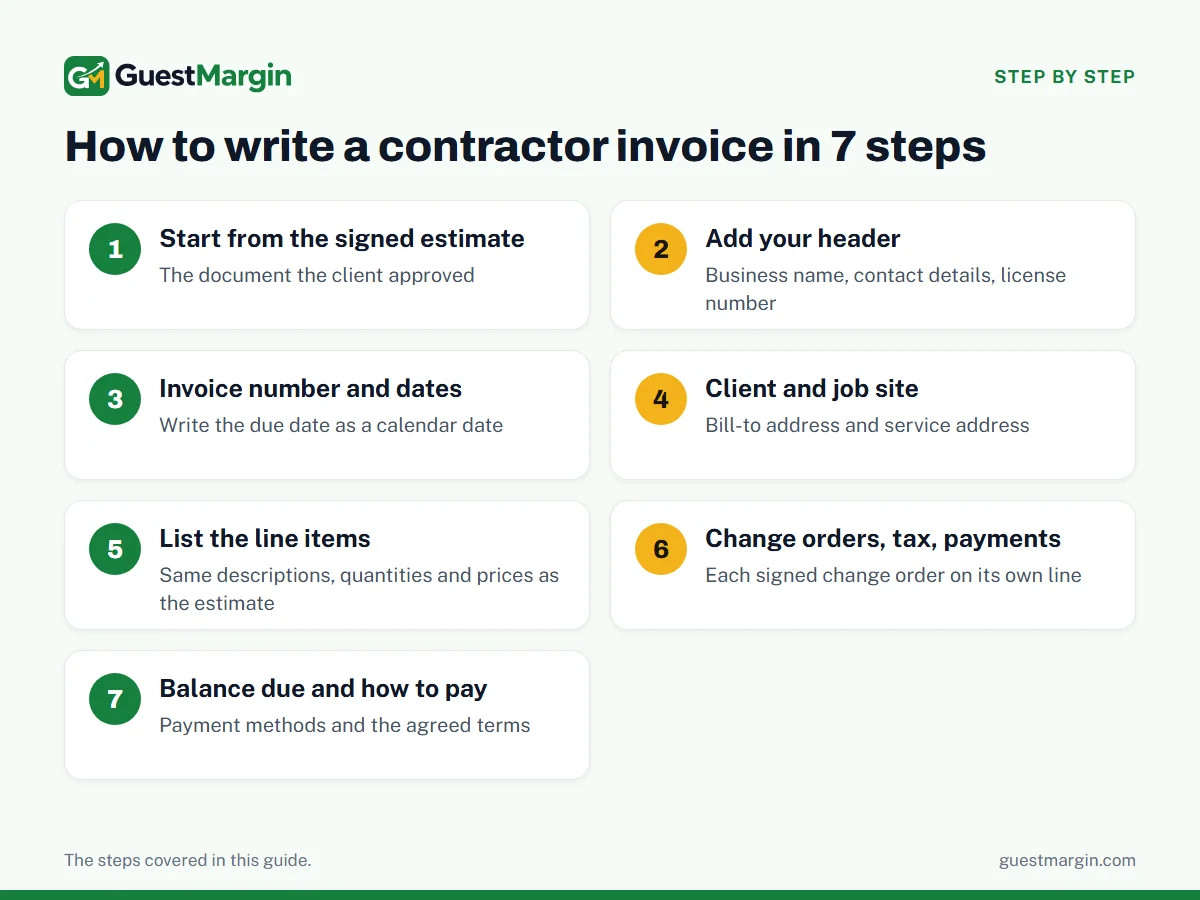
- Start from the signed estimate. The document the client approved is your baseline (here is whether to call it a quote or an estimate).
- Add your header. Business name, contact details and license number where required.
- Give it a unique invoice number and dates. Write the due date as a calendar date.
- Name the client and the job site. Bill-to address, plus the service address if different.
- List the line items. Same descriptions, quantities and prices as the estimate.
- Add change orders, tax and payments received. Each signed change order gets its own line.
- State the balance due and how to pay. Payment methods and the terms from the contract.
If you are still working out quantities, overhead and contingency, that belongs to the bid stage; see how to price overhead and contingency into a bid.
What Should a Contractor Invoice Include?
A contractor invoice should include your business and license details, a unique invoice number, invoice and due dates, client and job-site addresses, line items that match the estimate, approved change orders, subtotal, sales tax where it applies, deposits and payments received, the balance due, payment methods and payment terms.
If you are wondering what should be on an invoice for contractor work, the table below lists each element, why it matters and an example.
| Element | Why it matters | Example |
|---|---|---|
| Business name, contact, license number | Identifies who is billing; include the license number where your state requires it | Ridgeline Remodeling, Lic. #000000 |
| Invoice number | Unique reference for payment matching and records | INV-0142 |
| Invoice date and due date | Starts the payment clock; a calendar date avoids “net 30 from when?” arguments | Issued Mar 3; due Mar 17 |
| Bill to and job site | The payer and the property may differ (landlords, property managers) | Bill to: owner; Site: rental unit address |
| Line items (labor, materials) | Must mirror the estimate so nothing looks new | Demo and haul-off, 1 job, $650 |
| Change orders | Extra work billed only with a signed approval | CO-1: add GFCI outlet, $185 |
| Subtotal, sales tax | Tax treatment depends on your state and the type of work | Tax on taxable materials only, if that is your state’s rule |
| Deposit applied, amount paid | Shows the client you credited what they already paid | Less deposit received Feb 12: -$1,500 |
| Balance due | The one number the client needs to act on | Balance due: $4,420 |
| Payment methods and terms | Removes friction; restates what the contract already says | Check, ACH or card; due in 14 days |
Invoice requirements beyond the basics
The elements above make a clear, complete contractor invoice. Some invoice requirements go further and come from outside the invoice itself: some states add rules for contractors (license numbers on paperwork, sales tax treatment, deposit limits), and some contracts, lenders or general contractors specify a format, a billing date or backup such as lien waivers and signed change orders. Check your state’s contractor licensing board and your contract before you send the first invoice on a job.
If you priced by the hour, make sure the rate was your fully burdened labor rate, not the raw wage. The invoice is too late to fix an underpriced hour.
Sample Contractor Invoice
Below is an illustrative contractor invoice for a small bathroom refresh, built from a signed estimate plus one approved change order. It shows how the deposit and change order flow into the balance due, which is the part that is easiest to get wrong.
Illustrative example only. Prices are invented to show the structure, not market rates.
| Line | Description | Qty | Amount |
|---|---|---|---|
| 1 | Demolition and haul-off (per Estimate EST-0098) | 1 job | $650.00 |
| 2 | Install vanity, top and faucet (labor) | 1 job | $900.00 |
| 3 | Vanity, top and faucet (materials) | 1 set | $1,400.00 |
| 4 | Tile floor, 45 sq ft (labor) | 45 sq ft | $1,350.00 |
| 5 | Tile, thinset, grout (materials) | 1 lot | $620.00 |
| 6 | Paint walls and ceiling | 1 job | $520.00 |
| CO-1 | Change Order 1, signed Mar 1: add exhaust fan | 1 | $480.00 |
| Subtotal | $5,920.00 | ||
| Sales tax (rate and taxable lines depend on your state) | $0.00 in this example | ||
| Less deposit received Feb 12 | -$1,500.00 | ||
| Balance due by March 17 | $4,420.00 |
Lines 1 to 6 use the estimate’s wording. The exhaust fan appears as its own line with the change order number and date, so the client can match it to what they signed. Change orders billed this way are easy to check; change orders billed as a lump “extras” line are not. That is the payoff of getting extra work signed before you start it.
There is no markup or overhead line; profit sits inside each price. If you are unsure how much a price holds, read why markup and margin are not the same number.
How Do You Write an Invoice for Deposit Payments?
To write an invoice for deposit payments, send a short deposit invoice when the client signs the estimate, showing the job reference, the deposit amount or percentage and its due date. On the final invoice, list the deposit as “Less deposit received” with the date so the balance due is correct. Some states cap residential deposits.
You can put a deposit line on the signed estimate (“40% due on acceptance”, where your state allows it) or send a one-line deposit invoice with its own number (“Deposit for Estimate EST-0098: $1,500”). The separate invoice leaves a cleaner payment trail. Either way, credit the deposit on the final invoice; a missing deposit looks like an error and stalls payment.
Some states limit deposits. California, for example, limits the down payment on home improvement contracts to $1,000 or 10% of the contract price, whichever is less, according to the Contractors State License Board. Other states have different rules or none. Our guide to invoice payment terms covers deposits, due dates and late fees in more detail.
When Should You Use Progress and Final Invoices?
Use progress invoices when a job runs longer than a couple of weeks or ties up significant material costs: bill at agreed stages or by percent complete, then send a final invoice for the remaining balance and any retainage. Small jobs finished in a day or two usually need only one invoice.
The payment schedule belongs in the signed contract: for example, deposit on signing, a payment when rough-in passes inspection, another at substantial completion, and the balance at walkthrough. Each stage gets its own invoice number.
Commercial work may require a pay application with a schedule of values and retainage. See our guide to progress billing for how stage billing and pay apps work.
The final invoice shows the contract amount, all change orders, every payment received and the remaining balance.
Do Contractors Charge Sales Tax on Labor?
It depends on your state and the type of work. Some states tax repair labor but not new construction, some treat contractors as the end consumer of materials, and some tax most services. There is no national rule, so check your state’s department of revenue guidance for contractors before you add tax to an invoice.
Texas is a useful example of how much the type of work matters. The Texas Comptroller’s contractor publication says labor to repair, remodel or restore residential real property is not taxable, while the total charge for remodeling or repairing nonresidential real property is taxable. On new construction, construction labor is not taxable, and how materials are taxed depends on whether the contract is lump-sum or separated.
Your state may draw the lines elsewhere. Where the rules turn on it, separate labor and materials and mark which lines are taxable instead of taxing the whole total.
This is general information, not legal or tax advice. Sales tax rules depend on your state; confirm with your state’s revenue department or a tax professional.
How Should You Number Invoices and Keep Records?
Number invoices in a simple sequence that never repeats, such as INV-0001, INV-0002, or a year-prefixed series, and never reuse a number after voiding an invoice. Keep a copy of every invoice, estimate, change order and payment record. The IRS lists invoices among the supporting documents businesses should keep.
IRS Publication 583 names sales slips, paid bills, invoices, receipts, deposit slips and canceled checks as supporting documents, and says to keep records until the period of limitations runs out: generally 3 years, longer in some cases.
For simple recordkeeping, file each job’s estimate, change orders, invoices and payment records together under the job name or estimate number. When a client questions a balance, everything you need to answer is in one place.
When Should You Send the Invoice?
Send the invoice the same day the work is finished, or the same day a billing stage is reached on a progress schedule. Every day of delay pushes back the due date and makes the job feel older to the client. Put a calendar due date on it and follow up the day after it passes.
Send it at the walkthrough, offer the payment methods your clients use (check, ACH or card), and send a reminder a few days before the due date.
If an invoice goes past due and your contract allows a late fee or interest, you can work out the late fee or interest owed. The limits on what you may charge depend on your state.
For high volume, see our comparison of estimate and invoice apps for contractors.
Which Invoice Templates Fit Each Trade?
Each trade bills differently: HVAC lists equipment and model numbers, plumbers bill trip charges and fixtures, electricians list circuits and permits, cleaners bill by visit, and handymen bill mixed small tasks. Pick the template that already has your trade’s fields, then fill it in and print to PDF.
- HVAC techs can use the HVAC invoice template.
- Plumbers can start from the plumbing invoice template.
- Electricians can use the free electrical invoice template.
- Cleaning businesses can use the cleaning invoice template.
- Handymen can use the handyman invoice template.
Frequently Asked Questions
What should a contractor invoice include?
A contractor invoice should include your business name and contact details, license number where required, a unique invoice number, the invoice and due dates, client and job-site addresses, line items that match the signed estimate, approved change orders, subtotal, any sales tax your state requires, deposits and payments received, the balance due, and accepted payment methods.
How do I invoice a customer for a deposit?
Send a deposit invoice when the client signs the estimate, listing the job reference, the deposit amount or percentage and a due date. When the job is done, show the deposit on the final invoice as a credit with the date received, so the balance due is correct. Some states, such as California for home improvement work, cap how much deposit you can take.
Do contractors charge sales tax on labor?
It depends on the state and the type of work. Texas, for example, does not tax labor to repair or remodel residential property but does tax nonresidential repair and remodeling, according to the Texas Comptroller. Other states use different rules. Check your state’s department of revenue guidance for contractors; this is not tax advice.
How should I number my invoices?
Use a simple sequence that never repeats, such as INV-0001, INV-0002 and so on, or a series with a year prefix. Never reuse a number, even for a voided invoice; mark the voided invoice void and keep it. Sequential numbers make missing invoices easy to spot and payments easy to match.
Can I send an invoice before the job is finished?
Yes, if the signed estimate or contract sets up a payment schedule. Deposit invoices and progress invoices are billed before completion at agreed stages, such as signing, rough-in or substantial completion. Without an agreed schedule, billing early can surprise the client, so put the stages in writing before work starts.
The Bottom Line
A good invoice is a mirror of the signed estimate plus signed change orders, minus what the client already paid. Get the estimate right and the invoice almost writes itself; our guide to what a complete job estimate includes shows how.
When you are ready, use the free maker (no signup) to build the estimate, convert it to an invoice in one click, and print it to PDF. Starting from scratch? Use the contractor invoice template. It saves in your browser, with no account required.